Written in Salem, Idaho on January 31, 1899 by Sylvia's great grandfather, George P. Ward
The biography of your humble servant commences at the early dawn of January 1, 1828, at Newborough, Northamptonshire, England. I am the son of John Ward and Ann Woods, who were born at Eye, Northamptonshire, England, and North Lufnaham, Ruthlandshire, England, respectfully. My parents were in humble circumstances and the common education of life was not attainable, in consequence of which my education was limited. I spent the first twenty years of my life on the farm and at the time of the inauguration of the Free Trade Law, which proved to be very detrimental to the renters, my father was compelled to leave the farm. In consequence I turned my attention to the bakery and grocery business in which I was successful.
I was married March 28th , 1849 to Sarah Ann Plant who bore me four children. At this time we were living in West Walton in Norfolk County. There were no Latter-Day Saints in the vicinity until late in the fall of 1850. My wife and I first heard the Gospel preached on the first Sunday in January 1851, and were baptized on the 23rd, of the same month. I was ordained to the Priesthood in February following, and ordained an elder in March of the same year. I commenced my missionary labors on the day I was ordained an elder and was successful in the work, as we had a new branch of sixteen members: my father, mother, youngest brother, and two sisters being among the number. We had much joy in our labors for the Lord was with us.
At a conference held at Bedford I was called as a missionary, sold out my business and left on Nov. 1st , 1851, leaving my wife, child, father, mother, brother and sisters. I was appointed to labor at New Market and vicinity. After two weeks of continuous labors I was unable to get a meeting in the great town of New Market. I then directed my labors to the surrounding county and was very successful in so doing. In a small town called Seahim. I baptized sixteen unto the church, and a very successful branch was organized. After this I was appointed to labor in the Southampton conference, in the branches of which my labors were abundantly blessed in the bringing of many souls to the truths of the Gospel, and the building up of the various organizations. I labored in this conference during 1853 and 1854. In 1855 I was called to labor in Scotland and was appointed by the presidency to labor in the different branches of the Glasgow conference, in which I was blessed in the counseling of my brethren and the Saints.
In the reformation of 1857 my president (the president of the Glasgow Conference) baptized me after I had first baptized him, We together baptized forty of the members of the conference and continued our labors in this direction throughout the different branches, in which was manifest to us that we were all accepted of the Lord. During this year I was called by Apostle E. T. Benson to labor in the Dundee Conference; while laboring in this conference, I was up to hold a discussion for three nights at Airbraugh. The subjects were arranged by Apostle Benson, which ended in a perfect victory for the Gospel, my opponent having given up and was satisfied in two nights, he being incapable and not desiring to continue longer. After visiting the different branches, we went to old Bonie Aberdien where I received a call from the Liverpool office notifying me that I was appointed to preside over the Liverpool conference. A short time after commencing my labors in Liverpool I had the misfortune of losing my wife who was called by death; two weeks after the death of my wife, I also lost a daughter in death leaving me with two children to mourn the loss of our dear ones.
I had the good luck in getting Sister Clegg at Stockton (of Stockport) in whose tender care I placed my children, and by whom they were given every attention possible.
Continuing my labors with much pleasure and being blessed by the power of God, we labored diligently in the up-building, and bringing many to the cause of truth. In the fall of the same year I was called to preside over the Irish Mission. In connection with my brethren we labored with much satisfaction and with the blessings of the Lord. I was pleased with the opportunity to labor in this part of the Lord’s Vineyard. In the fall of 1858 I was appointed to labor in the Manchester Conference, having much pleasure in visiting the branches, and was an instrument in the organizing of branches that had become disorganized.
In July 1860, on July 21, I was again married, taking to wife Martha Monks, daughter of John and Alice Monks, and who was born Sept. 14th, 1839, near Bolton, Lanchestershire, England. (She bore me ten children. She died May 8th, 1899, after a useful life.)
I was appointed captain of the guard on the ship Manchester. We were 27 days and nine hours coming from Liverpool to New York. After a long and tiresome journey, we arrived in Florence, Nebraska and stayed in camp here for six weeks, leaving with ox teams under the care of Ira Eldgredge, arriving in Salt Lake City, Sept. 14th, 1861. Our riches consisted of fifty cents cash. My wife and two children had no shoes. All was well. We visited father and mother (John and Ann Woods Ward) at Ft. Herriman for six weeks and then started for Wellsville, Cache County, and arrived there October 25, 1861.
In November, my wife and I enjoyed the privilege of receiving our endowments in the Salt Lake Endowment house.
In March 1862, we moved to Hyrum, Cache Co. I was appointed president of the teachers quorum shortly after arriving, which position I held for fifteen years, acting on many occasions as bishop of the ward and was called as one of the (members of the High Council previous to the reorganization of the Stakes of Zion) appointees of organization of the Stakes of Zion. I had the privilege of being a member of the School of the Prophets. Shortly after this I was ordained a Seventy of the 64th Quorum.
During the epidemic of diphtheria there were seven of the family stricken, but by the blessings of the Lord we lost none.
On August 18, 1867, I married a plural wife, Sennie D. Nielsen, (daughter of Seron and Elsie Marie Nielsen, and who was born Sept. 25th 1846 in Yerring, Denmark) by whom there are nine children (Six of whom are living).
In the year 1871, I was again called to fulfill a mission in England, during which I was appointed as president of the Manchester conference, in which position I filled with pleasure and satisfaction to my brethren. On my return I was appointed captain of a company of 3 50 Saints sailing on the ship “Wisconsin.” In September 1872, I arrived home in the full blessing of health.
On reaching home in Hyrum I received a kind reception from my families who were all well, and from the saints who were glad to have me back. I employed myself on the farm and in the fall of 1873 I made up one thousand and fifteen gallons of sugar cane syrup.
At the time the Utah Northern railroad went through, I was cook for the company. Our quarters were at Richmond and Logan. After this I was agent for the Hyrum Lumber Co. in Logan. It was afterward called the Cache County Lumber Co. I was also secretary and treasurer for the Seventies of Hyrum, Paradise, Wellsville, and Millville. We employed two men to work on the Salt Lake Temple.
On March 30th , 1874, I again married, taking Jane Ashworth to wife. She was born Oct. 4th, 1853 and was the daughter of Edmond Ashworth and Alice Ashworth. She is the mother of four children. I left Hyrum in 1878 and moved to Randolph, Rich Co., Utah. From here we moved to Meadowville, Rich Co., Utah, and from there we moved to Snake River Valley, arriving in the latter place September 21st, 1884, and settled in Salem.
I have had a family of 27 children; 18 living and nine dead. I have 30 grandchildren and 13 great grandchildren.
"I don't know who my grandfather was, I am much more concerned to know what his grandson will be." --Abraham Lincoln
Friday, September 9, 2011
Thursday, September 1, 2011
From the corners of my mind…My Aunt Marilyn Francis Morris Carter
Marilyn Frances Morris Carter; daughter of Roy Alexander and Marquise Elizabeth Goodspeed Morris; sister of Robert Leroy Morris, Ruth Louise Morris Blimes, and Kenneth Edwin Morris; wife of Ned Darrell Carter; mother of Carolyn Dee Carter Highland, Virginia Lee Carter Puhl, Keith Darrell Carter, and Richard Alan Carter; my Aunt, my friend and my buddy.
One of my first memories of my aunt Marilyn was going to a movie in 1959 in Nelsonville, Ohio at the Majestic theatre, downtown on the square. I was 16 and
Marilyn was 28.
I was born in Nelsonville, Athens, Ohio to Ruth Louise Morris Blimes and Bill Blimes, Sr. in 1943. My dad joined the Navy and was away in the South Pacific fighting for our freedom when I was born. Marilyn was at just the right age to be a babysitter when my Mom needed one. Marilyn and I kind of grew up together and developed a special bond.

Back to the movie at the Majestic. The movie was North By Northwest, a suspense film directed by Alfred Hitchcock, starring Cary Grant, Eva Marie Saint and James Mason. Now when I say it was a suspense film, if you have seen any Alfred Hitchcock movies, then you know that he is the Master of Suspense!
A Madison Avenue advertising executive, Roger Thornhill (Cary Grant), is mistaken for a Mr. George Kaplan when he summons a hotel bellhop who is paging Kaplan, and is kidnapped by Valerian (Adam Williams) and Licht (Robert Ellenstein).
Knowing that Kaplan has a reservation at a Chicago hotel the next day, Thornhill sneaks onto the 20th Century Limited train. On board, he meets Eve Kendall (Eva Marie Saint), who hides Thornhill from policemen searching the train.
In an iconic sequence, Thornhill travels by bus to an isolated crossroads, with flat countryside all around and nobody in sight. A man finally arrives, but then takes the next bus. Before he leaves, the puzzled stranger observes that a biplane is "dusting crops where there ain't no crops." The plane soon flies towards Thornhill, and the pilot starts shooting at him.
They fly to Rapid City, South Dakota, where Thornhill (now pretending to be Kaplan) meets Eve and Vandamm in a crowded cafeteria at the base of Mount Rushmore. Thornhill learns that the Tarascan statue contains secrets on microfilm.Vandamm decides to throw Eve out of the airplane when they are flying over water. Thornhill manages to warn her by writing a note inside one of his ROT matchbooks and dropping it where she can find it.
On the way to the airplane, Eve grabs the statue and joins Thornhill. Leonard and Valerian chase them across the top of the Mount Rushmore monument. Valerian lunges at the pair, but falls to his death. Eve slips and clings desperately to the steep mountainside. Thornhill grabs her hand, while precariously holding on with his other hand. Leonard appears and treads on his hand. They are saved when the Professor has a police marksman shoot Leonard, who falls to his death, and Vandamm is arrested.
That is the story in a nutshell. If you want to watch a film full of excitement, adventure and intrigue, get a copy of North By Northwest.
Marilyn and I settled about half way down the theatre on the right side. As the plot developed and the excitement built, Marilyn began making little squeaking noises and reached over and gripped my hand. Half way through the movie she was shrieking and practically sitting on top of me. To say it was embarrassing would be an understatement. She kept saying “I have to leave, I’ve got to get out of here”. I would take her at her word and start to get up to leave- but she would grab me and pull me back into the seat and say, “No, I’ve got to stay to see what happens”. Then as the excitement would build she would start all over again. “I have to leave, I’ve got to get out of here”. I just wanted to get out of there but that was not to be. By the time we got to where Thornhill and Eve were scrambling over Mt. Rushmore and hanging off noses and eyelids, Marilyn was on the point of collapse. But we stayed for the whole thing and we have shared a lot of laughs about this together over the years.
I have many other memories of my aunt Marilyn. Going roller skating with her was always exciting. No matter if we went skating up above Haydenville or down below Nelsonville there would be people there that knew Marilyn and they would start calling for her to do her “trick”. She was a beautiful, graceful skater and she loved to skate. Finally the calls from the other skates would get louder than the music and the owner or manager of the rink would shut off the music and tell her to get out on the floor. He would then put on a waltz style song and she would begin to skate. She was such a smooth skater and she would swoop and glide all over the huge wooden floor. Then she would skate by the manager and he would hand her a kitchen match as she glided by. She would put the match in her mouth and start skating in a big circle that got smaller and smaller. Then she would begin to crouch down lower and lower until she got her mouth down near the floor, suddenly she would touch the match to the floor and it would flare into flame. No matter how many times we saw her do this, it was always magical.A Madison Avenue advertising executive, Roger Thornhill (Cary Grant), is mistaken for a Mr. George Kaplan when he summons a hotel bellhop who is paging Kaplan, and is kidnapped by Valerian (Adam Williams) and Licht (Robert Ellenstein).
Knowing that Kaplan has a reservation at a Chicago hotel the next day, Thornhill sneaks onto the 20th Century Limited train. On board, he meets Eve Kendall (Eva Marie Saint), who hides Thornhill from policemen searching the train.
In an iconic sequence, Thornhill travels by bus to an isolated crossroads, with flat countryside all around and nobody in sight. A man finally arrives, but then takes the next bus. Before he leaves, the puzzled stranger observes that a biplane is "dusting crops where there ain't no crops." The plane soon flies towards Thornhill, and the pilot starts shooting at him.
They fly to Rapid City, South Dakota, where Thornhill (now pretending to be Kaplan) meets Eve and Vandamm in a crowded cafeteria at the base of Mount Rushmore. Thornhill learns that the Tarascan statue contains secrets on microfilm.Vandamm decides to throw Eve out of the airplane when they are flying over water. Thornhill manages to warn her by writing a note inside one of his ROT matchbooks and dropping it where she can find it.
On the way to the airplane, Eve grabs the statue and joins Thornhill. Leonard and Valerian chase them across the top of the Mount Rushmore monument. Valerian lunges at the pair, but falls to his death. Eve slips and clings desperately to the steep mountainside. Thornhill grabs her hand, while precariously holding on with his other hand. Leonard appears and treads on his hand. They are saved when the Professor has a police marksman shoot Leonard, who falls to his death, and Vandamm is arrested.
That is the story in a nutshell. If you want to watch a film full of excitement, adventure and intrigue, get a copy of North By Northwest.
Marilyn and I settled about half way down the theatre on the right side. As the plot developed and the excitement built, Marilyn began making little squeaking noises and reached over and gripped my hand. Half way through the movie she was shrieking and practically sitting on top of me. To say it was embarrassing would be an understatement. She kept saying “I have to leave, I’ve got to get out of here”. I would take her at her word and start to get up to leave- but she would grab me and pull me back into the seat and say, “No, I’ve got to stay to see what happens”. Then as the excitement would build she would start all over again. “I have to leave, I’ve got to get out of here”. I just wanted to get out of there but that was not to be. By the time we got to where Thornhill and Eve were scrambling over Mt. Rushmore and hanging off noses and eyelids, Marilyn was on the point of collapse. But we stayed for the whole thing and we have shared a lot of laughs about this together over the years.

As we aged we stayed close. After I married, she and Sylvia became great friends too. She introduced me to a lifelong interest in birdwatching, square dancing and beachcombing on Manasota Beach, Florida.

Sunday, August 28, 2011
Adele Capet, Princess of France
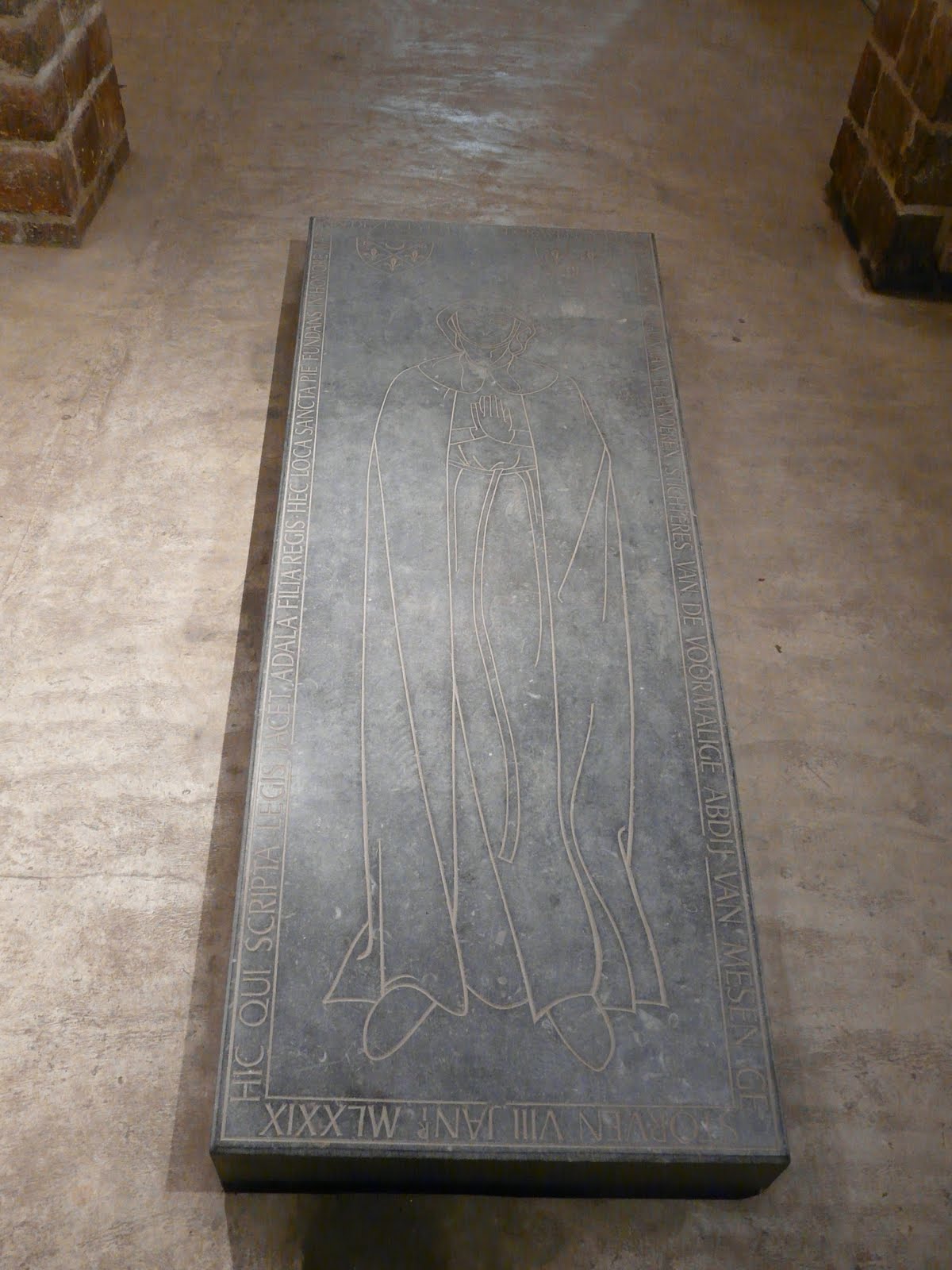
In the summer of 2011 we were driving in Southern Belgium in the area known as Flanders where many battles had taken place in World War I. We were driving with no particular destination. We followed signs as we saw them to battlefields and allied gravesites. Sometimes we would see a large church steeple on the horizon and we would drive over and check it out. As we were driving north we noticed a lovely church sitting on a small hill and we decided to take a look. We drove off the motorway onto a small country road that lead us to the village of Mesen or Messines. The church was even larger than it looked from the motorway. We parked the car and got out to take a look. The outer door was not locked so we went into the small foyer but no matter how hard we pulled and pushed we could not get the inner door to open. We walked back outside and walked around the grounds and took several photos of the church. Off to one side was an information sign that told us this was the Church of Saint Nicholas and there was a crypt that contained the grave of Adele, Countess of Flanders. I was surprised, to say the least. I had read about Adele because she was an ancestor of mine. I knew she was buried in Belgium but I could not locate exactly where. I had learned that her husband, Baldwin V, Count of Flanders was buried in a crypt in Lille, France. We had gone on a quest to find his grave and learned at the Office of Tourism in Lille that he was buried in a crypt that was located under the Palace of Justice in Lille. It seems there had been a church on the site but it had been destroyed in WW I and never rebuilt and the Palace of Justice was later built on the site. The crypt was accessible but was not open to the public. We had been disappointed but we carried on. Now we had stumbled on the site of his wife’s grave but couldn’t get into the church to see it. About that time a jogger came by and went up the steps to the church, went into the foyer and did not come out. I told Sylvia what I had seen so we went in again and this time when we pulled on the door into the Church it came open. The jogger left as we went in and we were left alone in the Church. Sylvia began taking photos and I wandered about. Sylvia was in a side chapel on the left and I went into one on the right. As I was looking at the wall hangings and the Alter I saw a door with the word crypt lettered at the top of the door way. The door was open and I could see a stairway going down into the basement of the church. Wow! Was I excited!
I called out to Sylvia and she joined me and we discussed whether we should go down or not. The lights had come on as I walked up to the door so we decided to go see what was there. I was surprised that Sylvia was going down into the crypt and that she was leading the way. For several years she has suffered from claustrophobia and has avoided small enclosed spaces.
But here we went - down several flights of stairs. The deeper we went the more odoriferous it became. It was a damp, rotten smell. We reached the bottom and went into the crypt itself and there in the center of the floor was Adele’s grave. There were statues located around the space and some pieces of stonework that were probably from the original church that had stood on the spot and then been destroyed during WW I.
I could hardly take it in. I was standing on a site that dated back to the eleventh century. Adele had died and been buried here in 1079. We talked in amazement at how serendipity had brought us here to this place. After some time had passed and Sylvia had taken a bunch of photos we turned to retrace our steps up the stairway.
Just as we turned to go into the hallway that lead to the base of the steps, the lights went out! It is surprising the number of thoughts that can go through your mind in a short space of time. I immediately thought “we are all alone in this church, no one knows we are here; I can find the steps and we can make our way up to the top but what if the door is locked; oh, yes, the lights are on motion detectors and we have been here so long they just went off because we had stood still for so long” and sure enough when I moved towards the steps, the lights came back on. What a relief. And what an awesome experience.
Here is some information I have found about Adele and the Saint Nicholas Church:
Adela Capet, Adèle of France, Adela of Flanders, Adela the Holy or Adela of Messines is one of my 28th great grandmothers. She was born in 1009 in Nevers, Nivre Department, Burgundy Region, France and died 8 Jan 1079 in Messines Benedictine Monastery, Messines (Mesen), West Flanders, Belgium. She was the second daughter of Robert, the Pious and Constance of Arles the King and Queen of France. As dowry to her future husband, she received from her father the title of Countess of Corbie. She was betrothed to her future husband at a very young age, in fact, she was carried to the betrothal ceremony in her baby bed. In 1028 at the age of 19 she was married to Baldwin V of Flanders (1012 † 1067) in Amiens. Their children were:
Baldwin VI of Flanders , (1030 † 1070)
Matilda of Flanders (1032 † 1083). In 1053 she married William Duke of Normandy , the future king of England
Robert I of Flanders , (1033-1093)
Henry of Flanders (c. 1035)
Sir Richard of Flanders (c. 1050-1105)
Adèle's political influence lay mainly in her family connections. On the death of her brother, Henry I of France, the guardianship of his seven-year-old son Philip I fell jointly on his widow, Ann of Kiev , and on his brother-in-law, Adela's husband, so that from 1060 to 1067, they were Regents of France.
Adèle had an especially great interest in Baldwin V’s church-reform politics and was behind her husband’s founding of several collegiate churches. Directly or indirectly, she was responsible for establishing the Colleges of Aire (1049), Lille (1050) and Harelbeke (1064) as well as the abbeys of Messines (1057) and Ename (1063). In 1057, Countess Adèle founded a Benedictine abbey for noble ladies. The abbey was transformed into a royal Institute by Empress Maria-Theresa (1745-1780) in 1776. After Baldwin’s death in 1067, she went to Rome, took the nun’s veil from the hands of Pope Alexander II and retreated to the Benedictine convent of Messines. There she died, being buried at the same monastery. Her commemoration day is 8 September.
Like the village of Mesen, the abbey was completely destroyed during the First World War. The crypt, located under the choir of the St. Nicholas abbey-church, was used as headquarters by the German staff, and has been preserved, as well as Adèle's grave. The church was rebuilt in 1928 exactly as it was before the war. It is lit by a big brass chandelier and wall lights made and donated to the church by Otto Meyer, a German veteran of the battle of Mesen.
Saint Nicholas Church (Mesen)
Originally the Benedictine abbey church of Our Lady leaning property and other abbey buildings.
After the abolition of the abbey in 1176 elevated to parish.
The church, with its domed tower, can be seen from miles away. The building was restored to its pre-war state in 1928. This church originally served as an abbey church for the convent of Saint Benedict and was erected by countess Adela of France. The church is adorned with a magnificent chandelier (1,94 metres wide) in yellow copper and many wall lights, designed for and given to the church by Otto Meyer, a German veteran who survived the battle of Messines.
The Crypt
This 11th century roman crypt is the only monument in Messines that is officially classified and protected. Countess Adela was buried here on 8th January 1079. She was the daughter of the French King Robert the Pious, wife of Baldwin V (Count of Flanders), mother of the English Queen Mathilda and thus "ancestress" of the British Royal Family. The crypt, where the Germans installed their headquarters, was restored in 1931 in its original state after the devastations of World War I.
The Peace Carillon
The carillon in the church tower has 59 bells. The first bell of peace (weighs more than 280 pounds) was inaugurated on 17th May 1985 in Ypres by Pope John Paul II. The carillon can be heard every 15 minutes, ringing out hymns from the nations that took part in World War I.
Wednesday, August 24, 2011
Bill Blimes Sr.'s Story as Written by him (My Dad)
In this picture-Harry Blimes & Mearl Edna Tolliver, parents of Bill Blimes Sr.
I was born 21 or 22 of November, 1921. The notation on the original birth certificate said midnight. My father always claimed one day and my mother the other.
My father was hurt in a coal mine in 1925. He was in the hospital for a year and was a semi-invalid after this. He was caught in a cave-in when shoring timbers gave way. He was lucky to get out alive.
At the time of my birth, my mother had been a member of the Church (of Jesus Christ of Latter Day Saints) for about eight years. Even though I was born into the church, so to speak, I never had any contact with the church, only through the missionaries who would come through our area once a year. They would stay for a few days or a few weeks and then be on their way to contact other members scattered through the area. My father never became a member of the church, but he was the most loving and generous man I've ever known. He really cared about people.
I had a happy, carefree childhood, with strict parents, but they always demonstrated to me a parental love that let me know their requirements for obedience was always for my best interests.
I can remember from my earliest days of looking forward to the visits of the missionaries, as they would come to our little home, without purse or script and hold church services in our home for a few days and then move on. This was always a high point in the year for the whole family, including my father, who was not a member of the church. I've often thought about this, and I've come to the conclusion that the reason he was never baptized is that no one ever asked him.
My childhood years moved along without any real sickness or tragedy or any remarkable events, until my eighth year. I was told that I would be baptized on this birthday. That was a pretty big word for me so I immediately rebelled. So my mother always said that I was baptized when I was 8 years and 2 days old. It took the missionaries 2 days to catch me. But they got the job done. I was baptized in the Hocking River when it was at flood stage, muddy and full of debris. I was confirmed there on the river bank and had the gift of the Holy Ghost bestowed upon me. However, I don't think it really "took" until many years later.
As I look back, the years passed swiftly, but happily. We still had very little contact with the church, until some years later. I can remember in my teen years, my grandfather and I would sit in the porch swing and he would always tell me about how he was going to run me for sheriff of Athens County when I grew up. Unfortunately he passed away before I was out of my teens, or else I would probably still be sheriff today.
As the years passed along, I entered school, liked it sometimes and rejected it at others. However, learning came easy for me and in later years I was sorry I hadn't pushed myself a little to become something more than I did. In my 5th year I received the gift of the book, "Little Men: for finishing the years spelling in a little over half the year. I was always tops in spelling bees.
On into High School, I played football, basketball, and baseball on the Nelsonville High School team. I was captain of the football team in my Senior year. I played the position of center on offense and linebacker on defense. I loved football and played all four years of high school. I didn't think I would like basketball, so didn't try for it in my freshman year. However, I did in my sophomore year and made the team. In the three years I played basketball in high school there was only one game I didn't start and that was a pushover on a Friday night and we had to play again on the next night on Saturday. I was proud of this.
While playing football, I had my left elbow broken on the first play of the game, and played the rest of the game with it this way. It hurt so bad that I had to rest it on my kidney pads and play with only one hand and arm. After the game was over, the doctor put my arm in a cast and it was on there for six weeks. On the day the cast was removed, Friday, the day of the last football game of the season, I played the entire game, both offense and defense. Some stupid trick; I'l suffer for it the rest of my life. I think if I had it to do over again, I'd bypass high school sports. I have too many mementos; crooked elbow, trick knee and crooked fingers and all sorts of aches and pains.
I graduated from high school in the 1938-1939 class along with 70 other seniors. Still in the throes of the great depression, no jobs were to be had.
I worked a couple of days for the Township (50 cents an hour) and the money went to help put food on the table.
Two months after I was out of high school, 17 years of age, I boarded a train in Athens, Ohio as a member of the CCC and headed for Darby, Montana. I had never been away from home overnight before this time. I had been raised in a home where there were few of the luxuries of life, but lots of love and family togetherness. I was very homesick for a while, but threw myself into the work of the Forest Service and managed to survive through the first few weeks.
Fighting forest fires, cutting huge trees, splitting wood, building log cabins, irrigation ditches, ski slopes and not least of all, packing in 18-25 miles, hiking day and night to reach a forest fire, to bring under control so we could save the countries forests. This was the sort of life I lived for the time I was in Montana; bedding down in a sleeping bag on a mountainside and going without a change of clothing for as long as two weeks at a time. But it was a good, healthy life and I've never regretted the year I spent in the CCC Camps.
I returned home from Montana to find that there were still no jobs to be had, so I decided to once again try the 3 C's. I signed up, knowing what I was getting into this time and was scheduled to go to Idaho this time. But something wonderful happened. While waiting for my orders for transportation west, I decided to go roller skating. While there I had a collision with the person who turned out to be my partner through life. Not withstanding the fact that she knocked out two fillings from my teeth and gave me various other pains and bruises, this was the turning point of my life. We began dating and I decided to pull some strings and stay in the camp where I was at the time instead of going west. I accomplished this without too much trouble because they were badly in need of a 1st baseman on their ball team. Romance blossomed in my life and in the next few months, Ruth and I saw an awful lot of each other. We decided we would get married on her 18th birthday, but I begged off from this date because there was no way I could afford a wife. Jobs were still scarce and not to be had. I was still in the 3C camp when my uncle became general manager of Bendix Aviation Corp in Wayne, Michigan. He offered me a job testing aircraft carburetors, and with that offer, I was able to get an honorable discharge from the 3C's. I went to Michigan to take this job, along with my brother, Harry, and with this action I became an independent, employed citizen with my future assured, so I thought.
It was while I was working in Wayne, Michigan that I was married to my life's companion. The event took place on Friday evening at 9:00 P.M. in the home of Rev. Morris in St. Clair Shores, Michigan, May 16, 1942. Cliff and Mary Lewis, uncle and aunt of my wife, stood up with us and signed as witnesses. After the ceremony, we each called our parents and informed them. I remember my mother telling us that we were too young to marry (Ruth was 19 and I was 20. I hoped that she was proven wrong.
Just a few months after I was married, on Dec 7, 1941, the Japanese bombed Pearl Harbor. I was at work, when the news came and little did I know at this time the extent of what my involvement would be. Pres. Roosevelt immediately declared war on the Nation of Japan and while he was at it
he also declared war on Germany, Italy and all of their allies. I wanted to be in the conflict, but was torn between two loyalties; a pregnant wife and my country. Ruth cried when I informed her that I was going to enlist in the Navy, but this only deterred me for a short time. On Sept 9, 1942, I took the oath of allegiance to the United States of America and officially became a member of the United States Navy. I took this oath of allegiance on Central Square in Cincinnati, Ohio along with about 200 other young men, all eager to fight. I was transported via railroad to Chicago, where I spent 31 days in Boot Camp learning, I'm sure, regimentation. At the end of this period I was sent to Electrical School at Purdue University in Lafayette, Indiana.
After 16 weeks of intensive schooling, I received the rating of Electricians Mate 3/C Petty Officer and was assigned to the U.S.S. Portunus, a P.T. Boat tender and repair ship. We carried the depth charges, high octane gasoline and torpedoes for the P.T. boats. We were a floating bomb hunting a place to go off. I stayed on this ship until the 5 Sullivan Brothers were lost on one ship. After this event, a directive came out saying that brothers could no longer be assigned to the same ship. As my brother, Harry and I were both on the Portunus, one of us had to go. I was picked as the one to be transferred, so shortly thereafter, I found myself at the Naval Receiving Station in Brisbane, Australia awaiting re-assignment. This came immediately. I, along with four others, was taken to the Hotel Darby in downtown Brisbane and billeted on the 3rd floor of the hotel. This was to by my home for the next 8 months. I was assigned to be one of Admiral Thomas C. Kinkaid's body guards, with a 45 automatic strapped on my hip. This was not a happy time in my life. I was lonely, homesick and had a useless feeling because this was not what I joined up to do. I stood it for as long as I could and one day I walked into Commander Burwells' office and asked for a transfer back to sea. My request was granted and I headed back to the USA on a Dutch luxury liner which was being used by our Navy to transport personnel back and forth across the Pacific Ocean. After 30 days leave at home, I reported to Little Creek, Virginia for Mine Warfare training.
After completing this, I went to an advanced Mine Warfare school and at the end of this time, I was assigned to duty on the U.S.S. Hambleton, DD 455. After removal of gun turret #4 and installing special mine sweeping gear, we became High Speed Mine Sweeper # DMS 20 and joined with 14 other destroyers to make a pack of 15 high speed.
I was the Mine Warfare Specialist on our ship and was treated pretty good until I taught the executive officer and a couple of others some of my trade. After this, they became the specialists and I became the peon. Such is life! Duty on this ship lasted until after the end of WW II. I had some good experiences on board, but the bad far out weighed the good, that I do not choose to remember much of the time I spent on the U.S.S. Hambleton. War to me is hell on earth. A person should never have to be subjected to this kind of experience. The thing that stands out most in my mind is the four times our ship was relieved from anti-aircraft screen, the relieving ship each time was sunk within a half hour after having relieved us. What is the answer for this? I don't claim to know.
The war finally came to an end and soon after I was headed for home. What a happy day this was, when we finally found a ride from Okinawa to Seattle, Washington. This came after three weeks of living in the rainstorms and mud on Okinawa. This was a taste of the kind of life the GI's had throughout the war. I was certainly glad that I had been in the Navy. A clean bunk every night, regular chow, clean clothing; the things that really count when it comes to comfort and well being.
Finally I was discharged and arrived home Nov 19, 1945, 2 days before my 24th birthday. Three years taken from my life and nothing to show for them but an unsettled mind. I could not really adjust to civilian and married life right away and had no desire to go back to work. I moved in with my in-laws with my wife and child (a young son also named Bill) and just drifted aimlessly for a few months. I began to come out of it in the spring of 1946 and let my father talk me into buying half interest in a small restaurant. My brother was my partner. It didn't take me long to realize that this wasn't my niche in life, but it did serve a purpose, it put me back into a frame of mind to go to work again. After a year and a half of restaurant life I quit and went to work for a small appliance dealer and electrical contractor as an electrician. I had worked for him almost two years when television first came out, and began selling in goodly numbers. I decided that this would be a good field to get into, so once again I quit my job. This time it was two weeks before Christmas. It was a slim Christmas for us on Dec 25, 1949. I enrolled under the GI Bill at Franklin University in Columbus, Ohio and started to school early in January of 1950. I graduated from Franklin University and already had a job in Towson, Maryland with Radio Division of Bendix Aviation. I stayed in Maryland on this job for almost a year, but it was too far from home for my wife. We had to make too many trips back to Ohio. So once again in December, I quit my job on a Friday and started to work the following week with North American Aviation Corporation in Columbus, Ohio. This was December 12, 1951. For the next 10 years I spent at N.A.A. Finally, it was here that I really began to be introduced to the church once again. I have to admit that I was not too interested, but I made friends that have lasted throughout the years. I gained a good reputation at N.A.A. for being able to get things done properly. I was chosen to be the Electrical Leadman in charge of all electric circuitry and operations on the first airplanes on the FJ-2, FJ-3, FJ-4, T1J Trainer, F-100 and the exotic C5A, supersonic aircraft, with auto pilot and the first one with an inertial navigation system. Ten happy and luxurious years with this company and once again I was looking around for greener pastures. I took a day off from work and went to Newark, Ohio to check into a job that was going to open up there. It was with the United States Air Force and it was in the field of inertial navigation systems for missiles. This really sounded interesting. It was not only a new field, but also another source of income after retirement time. And I could count the 3 years and 2 months I'd served in the Navy toward this retirement. This really sounded good to me.
I was accepted for employment by the Air Force and reported for work June of 1961. I was assigned to the Titan Missile program and was told I would receive schooling in Milwaukee, Wisconsin. I looked forward to this very much. The time finally came for me to go to Wisconsin, so three of us pooled our funds and purchased a house trailer to live in up there so we could save money.
When school was out in Newark, my wife and family (4 children by now) came up to join me. Something happened to me, however, that changed my entire life.
This happened shortly before I left N.A.A.
I had drank and smoked for years. I drank beer because I really liked it. But I had been attending church once in a while, and I was beginning to feel that maybe there was something to it after all. It was New Years Eve, all the family was in bed but me, and I sat all night thinking and pondering the values and priorities that I was placing first in my life. I came to the conclusion that I had things all backwards, so I decided to do something about it. I committed myself to quit smoking and drinking and to become active in the church and see what the Lord had in store for me. Again, I thought about the times that my life had probably been spared, when I had been in the Navy and other men had died in the places I had just left. I thought that maybe I had been spared for something better than I was allowing myself to receive.
I never smoked or drank after that night. I've heard of the great difficulty that some people have in stopping these vices, but I had no trouble at all. My desire to partake of them left me, when I made my commitment to seek after a better way of life. From that time to this my life has been one church job after another and I've loved all of them.
But back to Milwaukee, we attended church in a small Branch in Racine while we were there. They made us feel at home as they accepted us into their family. The stay in Milwaukee was happy as well as profitable.
Back to Newark and settling into a routine of work and church. I was called into the Stake High Council immediately after my return. I served almost 5 years in the position with President James L. Mortensen as Stake President and following him President Ralph M. Johnson. Also served under President H. Clay Gorton for awhile and then was released to become Branch President of the Newark Branch for the 2nd time. While serving as Branch President, I was called to be the first Bishop as the Newark Branch became the Newark Ward. This was a great honor and blessing.
I was sent to California because of my job and due to the length of time I was to be gone, I was released from the office of Bishop before I left Newark.
My wife and youngest son, Mark, went with me this time, as the other children were off on their own interests. This was like a paid vacation because I received expense money while there. I worked at night and that left me pretty much free to sight see in the daylight hours. It made for an enjoyable visit to California.
When I returned to Newark I worked on the Guidance System for the Minuteman Missile. Although it has been updated, I am still in the same position today, calibrating and testing the guidance system for the Minuteman III Missile.
I served as Scout Master in the Ward after I returned from California and this was a position that I really felt I was suited for. I had the privilege of taking some of my scouts on a ten day camping and 50 mile canoe trip in Minnesota. This trip we really roughed it. What beautiful country there is in Minnesota? How I would love to live there.
One morning on January 12 I had a heart attack and was confined to the hospital for awhile and this kind of slowed me down. I was released as Scout Master in the Ward and for the first time for many years, I was without a job in the church. What a desolate feeling this is. After having been wrapped up in other peoples lives and cares for so long, to suddenly be cast aside. My testimony wavered a little, and then I was called to be a counselor to the Sunday School President. Happy day, I'm needed again. But just a couple of months here and I'm released and called as teacher of the Gospel Doctrine Class. I've always wanted to be a Sunday School teacher so I accept this very gratefully. I had just begun to get my teeth into this teaching job when I am released again.
This time I'm not called to another job. I feel as if I'm only being used as a stopgap until the Lord finds time to call the proper person to the job I'm in.
I'm called in and asked if I would serve in the Sunday School Presidency again. Of course, I say yes. But again, in just a few weeks, again I'm released without another call. It was then that Sister Patty Paisola said something to me that made me much more able to go through these calls and releases. She said to me, "Bro Blimes, the Lord really must have something special in mind for you since he's giving you the experience in all these areas." I don't think she knew it, but these words were spoken to me at just the right time to cause me to pause and think that just maybe she was right and this gave me the strength and courage to continue on and wait patiently for the calling the Lord had in mind for me.
Not too long after this, I was interviewed by a member of the Stake Presidency and called to be the High Priest Group Leader in the Ward. I don't know how other people feel about it, but I know that nobody could like to visit the Temple as much as I do. I love the work that this calling entails and I pray I might be able to in some way help the Ward membership. It is through Genealogy work and temple work that families are perpetuated throughout the eternities. I don't know yet if this is the calling that Sis Paisola was referring to, but I'm certainly enjoying it at this time.
DOWN ON THE FARM Part 3
It was a great time and place to be a kid. I never felt at risk in any situation I was in. There was a big world out there and I wanted to discover all I could about it. Aunt Emma really encouraged me in this pursuit. Even today, at my age, I still am always looking for new and exciting places and experiences. Aunt Emma believed in encouraging kids to be what they wanted to be and to be comfortable in their own skin. If I wanted to catch a snapping turtle and kill it, clean it and cook it, she was right by my side helping me to do it. If I wanted to learn to sew, she would simply say, “What do you want to make?” When I wanted to have a party and invite my friends for a cook out, she was right there helping me make decorations and favors and planning the menu. One time I wanted to have a Luau and she came up with a way to take colored paper napkins, fold them, cut them and string them on thread to make leis.
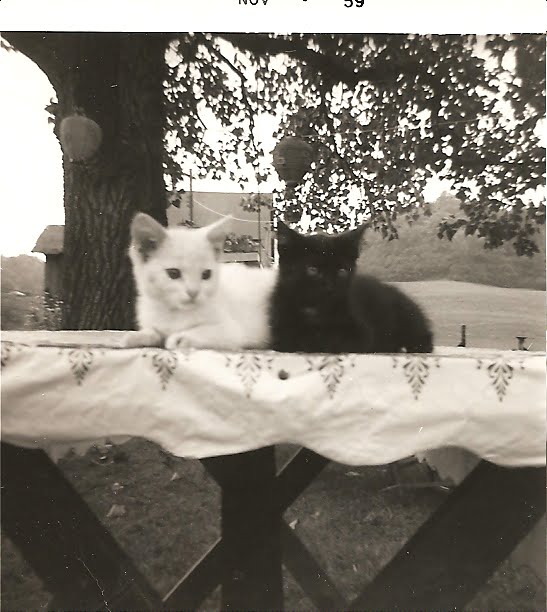
There were two large porches on Aunt Emma’s house, one on the front and one on the back. She had a chaise lounge that was on wheels and sometimes it would be on the front porch and sometimes on the back. She always had two or three cats and/or kittens around. On hot nights I would sleep out on the chaise lounge with a cat or two curled up with me. I would usually have a sheet or light blanket to pull over me as it often got cool by morning even on the hottest August nights. The sheet also served another purpose. It was a barrier against attacks of the killer mosquitoes. Boy, could those things bite and did they ever itch. One year Larry had a pup tent and we set it up in the side yard and we planned to sleep out in it. At some point during the night, Larry poked me and said he heard something outside the tent. I listened and soon I heard something give a loud growl. Man, we were both out of that tent like a shot! It’s a wonder we took time to unzip the door. Then next day we tried to figure out what it was and decided it was probably an opossum or raccoon having an argument with a cat about some food or something we had left outside the tent. I don’t ever remember attempting to sleep out in the tent again but it sure didn’t stop me from sleeping on the porch.
I also remember on warm summer nights sitting out in the yard looking up at the dark star studded sky and watching for the Russian satellite, Sputnik. The Sputnik program was a series of robotic spacecraft missions launched by the Soviet Union. The first of these, Sputnik 1, launched the first human-made object to orbit the Earth. That launch took place on October 4, 1957 as part of the International Geophysical Year and demonstrated the viability of using artificial satellites to explore the upper atmosphere. It was amazing to us that we could look up and see it with the naked eye as it orbited far above us in the night sky. This was the stuff of Buck Rogers, and those of us who grew up on his exploits in outer space, were fascinated that space exploration was really possible. The satellite showed up as a moving light crossing the sky far above us. At this time, well before all the sightings of commercial air planes crisscrossing the sky that we see today, seeing a moving light in the sky was a big event.
Frank and Eva’s nieces, Lynn and Rosie, used to come over and visit them and we all became friends. It was a much simpler life in those days. Boys and girls could be friends with out everyone assuming they were more than friends. As I look back now, I feel sorry for kids who don’t have the kind of youth we had. But for several summers, Lynn, Rosie, a neighbor boy, Corky and I ran around together. We would go to movies in Athens, go to the fair, have cookouts and have great summer parties. Lynn and Corky were both in 4-H and so we went to the fair to show off their projects. She liked to sew her own clothes and I remember going to a fashion show at the fair where she modeled a dress she had made. I think I may even have a photo of her wearing that dress at the fair. Corky usually had a calf or lamb at the fair and I would spend the nights in the barns with him. The four of us would also mess around in the barns doing kid type stuff. I think I have a photo of Rosie on her hands and knees up on a sheep grooming bench. And then there were the rides and sideshows. I remember once Corky and I were riding the giant swings. As we went around one of his cowboy boots flew off his foot and sailed over on top of a nearby vendor tent. We had to go looking for it after we got off the ride.
I always had a lot more free time to roam the hills than Lynn, Rosie or Corky. They were farm kids and usually had to do chores to help out on their family farms. But we still found time to explore and discover the wonders of nature. I recall a huge woods back behind Frank’s farm where there were huge beech trees. They were gigantic and walking under them was a little creepy. There was very little noise, no sunlight, and not much undergrowth.
We also went to Bible School at the Presbyterian Church in Amesville for part of the summer. I remember at the end of one summer we were doing a play or some sort of end of Bible School Activity and my Mom arranged to come and get me to take me home on the same day so she could attend this activity. At one point in the program, it was time to pass the collection plate, and I was one of the people chosen to do this. Mom was appalled that I would do such a thing. We did not go in for this sort of thing at our church.
Aunt Emma was very involved in a couple of community activities held every summer. One was the Fireman’s Festival, a street fair held in Amesville and the other was the Grange Booth at the Athens County Fair. She would always enlist me in helping with these activities. The first one, The Fireman’s Festival was held to raise money to help support the local Volunteer Fire Department. A side street in Amesville was closed off and there would be games and activities to participate in. Games like ring toss, pitching pennies and bingo were held in booths on the street. In the firehouse the trucks would be parked outside and long tables were set up and a ham and egg supper was served for a price. Everyone in the community supported this activity. For a couple of weeks before the event, Aunt Emma and I would drive the country roads all around Amesville, soliciting donations for the dinner and prizes for the booths. I loved riding these roads with Aunt Emma as she was always willing to stop if we saw something we thought we might use in a craft project. I remember one time we were going by someone’s garden and she saw some seed pods that interested her. We stopped and picked a few (they were radish plants that had gone to seed) and took them home to dry to use in dried flower arrangements. Another time we stopped to look at a tree that was full of some type of fruit I had never seen before. It turned out to be a persimmon tree and I can still feel the pucker of my mouth when I tasted one of them. Aunt Emma said they became very palatable after a frost had hit them. And we were always scouting for hickory and walnut nut trees, which she and Larry would come back to in the fall to pick up nuts.
The Grange Booth at the County Fair was another big event in our summer lives. Once again we would get the car and visit grange members around Amesville. Aunt Emma would get promises from people to bring examples of their farms’ produce and flowers to use in the exhibit. I remember there were very specific requirements for the booth. There had to be a flag, a bible, and various other items displayed in the booth. Each year there would be a different theme to follow but it all built around canned and fresh fruits and vegetables, and other things produced by the farms of the area. We would also use corn and wheat stalks, dried weeds and seeds we would gather along the roads and anything else we could gather up as we drove about. It was a fun time when everyone got together to put the exhibit together. As I got older and became involved in 4-H and other activities, I didn’t have time to help as much as I had but I still always rode around with her looking for stuff along the roads and lanes of Ames Township.
It seemed like everyone in the county went to the fair. Even Eva got dressed up in her hat and good dress to go to the fair. I have a picture of her by the seating on the hillside where we would sit to watch the horse races. It was the only times I ever saw her dressed up. She usually had on an old dress with a heavy duty apron on over it. This was what she wore in the barn and she had a similar outfit she wore around the house. I don’t think I ever saw her without an apron on except at the fair. Frank always wore the same type of clothes no matter where he was or what he was doing. He wore a work shirt and work pants, as I remember they were tan in color.
DOWN ON THE FARM Part 2
THANKFUL THURSDAY-as suggested by geneabloggers. My aunt, Emma Bryson Morris, inspired my love of nature and my enthusiasm to share this joy with others.
My aunt Emma's neighbor, Frank, would hire me to help with the haying. When I first started going down there he put his hay up loose. He used a fork type piece of machinery called a Buck Rake. It fit on the front of the tractor and had long tines made of wood that stuck out in front of the tractor. It could be raised and lowered by hydraulics. He would drive the tractor along the windrow of hay that had been raked up and the hay would pile up on the tines until he had quite a large stack of hay. Then if he was storing it in a haystack he would drive to where we were building the stack of hay and raise the forks up to the top of the stack and my job was to pull the hay off, scatter it around on top of the stack and tromp it down. This was not one of my favorite activities. However, if we were putting the hay in the barn haymow, we would load the hay onto a wagon until we got a big pile and then haul it to the barn. At the barn there was a large inverted U-shaped piece of equipment hooked to a series of pulleys and ropes that we used to transfer the hay to the mow. The top of the U was hinged and the ends of the U were a little more curved in than a U. This made it so we could squeeze huge clumps of hay to the inside of the U. On Frank’s farm a tractor was hooked to the end of a rope and walked out from the barn. As the tractor was backed away, the U full of hay was raised up into the top of the barn where you pulled another rope that transferred the U of hay to a second rope that allowed you to pull the clump of hay to the part of the mow where you wanted to stack the hay. Then a third rope was yanked and the U spread apart, dumping the hay where you wanted it. Then someone would spread the hay out and tramp it down. At a neighbors that I sometimes helped with the haying they still used horses for this part of the job. My job with this method was to work the horse. I could either lead it or ride it to raise the hay up to the haymow. Which method do you think I would use?
One year I was pleased to find that Frank had invested in a hay baler with his brother. Frank would go out the day before we were going to bale and cut the hay. Then the next morning he would take the hay rake pulled by the tractor and rake the hay into windrows. The windrow is formed by a hay rake, which rakes hay that has been cut by a mower machine into a row. If the weather was just right we could start baling in the afternoon. The goal was to get the hay cut, raked, baled and into the barn before it rained. So when it came time to make the hay, I would ride on the hay wagon which was pulled behind the baler which was pulled by the tractor. The hay in the windrow is lifted by tines into the baler's pickup. The hay is then dragged or augered into a chamber that runs the length of one side of the baler. A combination plunger and knife moves back and forth in the front end of this chamber. The knife, positioned just ahead of the plunger, cuts off the hay at the spot where it enters the chamber from the pickup. The plunger rams the hay rearwards, compressing it into the bales. A measuring device measures the amount of hay that is being compressed and, at the appropriate length it triggers the mechanism (the knotter) that wraps the twine around the bale and ties it off. Another conveyer would then move the bale out onto a shoot that brought the bale up near the front edge of the wagon where I would be standing with a hay hook in my hand. I would reach down, hook the bale and pull it onto the wagon. Then I had to drag the bale back, lift it up and stack it. We would continue this process until we had a full wagon of stacked bales. It was fairly easy until you got to the front of the wagon and had to stand on bales and reach way down to hook the new bale and drag it up and find a place to stack it. We put up a lot of hay this way for many years. I loved working in the hay fields because we would often find baby cotton tail rabbits that had been disturbed by the hay making process. I would jump off the wagon when I saw one, grab it, put it in my shirt pocket where it would crouch down and be back up on the wagon ready to grab the next bale. I would take these bunnies home where I fed them with an eye dropper until they were old enough to turn loose. Making hay was hot, dirty, itchy work. I was always happy at the end of the day because I knew how good the water would feel when I jumped into the creek to wash and cool off. And for this marvelous experience I would get paid the magnificent sum of one penny per bale. On a good day we would do about five hundred bales.
I loved going “back on the hill” for the day. Sometimes I would take a lunch, two water buckets and my little berry pail and pick blackberries. I would stay out until I had both my buckets full. I hooked my berry pail (a small container with a handle) through my belt so I could pick with both hands. When I got the pail full I would dump it into the larger buckets. I knew where all the biggest and juiciest berries grew. I picked berries for Aunt Emma, Grandma Morris and my Mom. Aunt Emma would make the berries into juice and can it in quart jars for Grandma and Mom to make jelly and jam. In addition to making jelly and jam, Aunt Emma would make pies and a berry pudding. I really liked the pudding. She made it in a bread loaf pan and it had the consistency of cake. We would slice it and eat it with milk on it, hot or cold.
Other times I would just go exploring. I liked being off by myself, pretending I was an explorer in some strange lands. I always carried a paper grocery sack folded up small in my back hip pocket ‘just in case’. Sometimes I would bring home bits of moss, ferns, flowers and rocks and chunks of wood and make a terrarium where I could put snakes, toads, tiny tortoises, or strange bugs I found. Other times I took a net and would catch butterflies and other insects for my collection. I would tramp up hill and down; I especially liked to walk along dry creek beds that came down off the hills. Sometime I would find things like; an empty tortoise shell, small animal skulls and bones, and other interesting junk I would drag home. I wonder that Aunt Emma put up with all my stuff. But she would show interest in what I brought home and help me figure out ways to preserve and display my treasures.
When I would go back on the hill, I might be gone all day and never see another person or a house. There were deep valleys, thick woods with gigantic trees, and even a rock cliff. One time I was sitting up on the edge of the cliff and I saw something moving across the valley at the edge of the woods. At first I thought it was a large black dog but then I realized it was a bear. Now when I was a kid, there were very few deer or other large animals to be found. It is only after I became an adult that the deer, bear, and mountain lion numbers increased to where their sightings became fairly common. So when I went home that afternoon and said I had seen a bear, I’m not sure I was believed. If only I had had a camera. But it probably wouldn’t have shown up in a picture as cameras then were not like cameras of today.
Subscribe to:
Posts (Atom)